
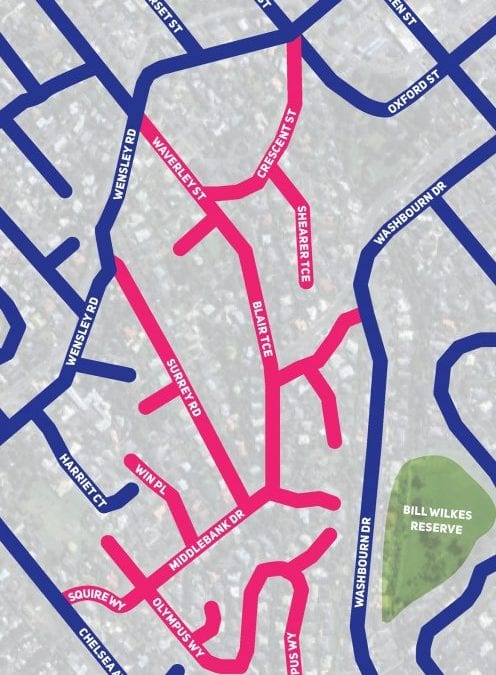
Over 400 Richmond households will be affected when the streets they live on get transformed into Neighbourhood Greenways by the end of the year. Tasman District Council have earmarked 15 streets that need attention after concerns were raised over road safety.
“Neighbourhood Greenways are streets where vehicle numbers and speeds are reduced and commonly incorporate physical changes to ensure low speed environments,” says Chris Choat, community relations manager for TDC. “It could involve a street that is one-way for motor vehicles but allows people to cycle in either direction, via a contra-flow cycle lane or separated path.” The changes could also include street closures, speed humps or cushions, and reduced speed limits.
Members of the public went along to last week’s co-design meeting to discuss current problems. Main concerns included the high speeds at which vehicles fly through the neighbourhood, as well as on-street parking. With limited parking in Richmond town centre, residential streets are becoming overrun by workers who leave their vehicles there for the day.
Ruby Aberhart, 90, who has lived on Crescent Street for 25 years, says, “Parking is on both sides of the street, so we struggle to get in and out of our driveways as the roads are so narrow. Sometimes it’s hard to get a space outside too. We hardly ever leave the house now as cars coming speeding along.”
This issue also affects emergency vehicles as they are unable to drive down the road due to lack of room. A resident recently suffered a cardiac arrest and emergency services had to park 40m away and walk to the property because of limited access. “It’s only a matter of time before a really serious accident happens,” says Ruby.
She also raised the issue of overhanging foliage which decreases pavement size and often makes surfaces slippery. “Walkways should be kept clear for the safety of everyone,’ she says.
Senior transport engineer for TDC Mike Van Enter says, “Getting the community involved in planning is quite new for us. Normally we’d sit around a table and come up with a solution and then put it into place. This way, we get to hear from the people who this will affect from the outset.”
During the next two months, the council will meet with residents to further discuss ways each street can tackle their issues. Then, in September, the temporary or permanent solutions will be confirmed. The implementation stage comes at the end of the year and a review on how things are working out will take place in February.
“Temporary solutions are helpful because it means we can trial ideas before they are set in stone,” says Mike. “If they are successful with residents, we can keep them or make changes if they are needed.”