
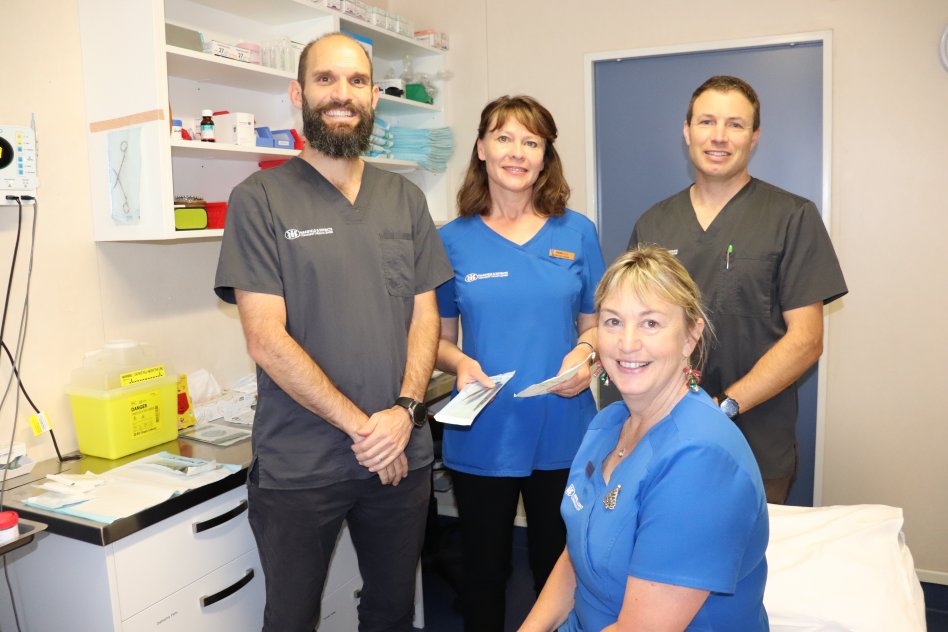
Specialists operating on patients with skin cancer were clogging up the hospital system, and GP’s have stepped up to help. Dr Mark Fry and Dr Wayne Hurlow are helping to reduce waiting lists and costs, and increase convenience for patients.
“Nelson-Tasman has one of the highest rates of cancer in a country that arguably has the highest rate in the world,” says Mark.
And it is increasing. In the past five years, referrals for skin cancer surgery have increased by 50 per cent.
Mark and Wayne are General Practitioners with a Special Interest (GPSI’s). Although not specialists, they have two years formal training in skin cancer care including study at the Skin Cancer College of Australasia, and they have six months working with a specialist in a hospital.
“The whole idea of GPSI’s is to bring patients out of the hospital into general practice, to free up the hospital and the specialists,” says Mark.
Patients with probable skin cancer can be referred by their regular doctor to the skin cancer service. Referrals are sorted into three categories by Mark alongside general surgeon Dr Susan Seifried. From there, some patients are returned for GP care, some are referred on to specialists, but many are referred to the GPSI’s. Because the GPSI service is funded by the primary health organisation, it is free to the patient.
“Over a year we triage about two and a half thousand patients,” says Mark.
Patients who are referred to GPSI’s will usually have their initial consultation within eight days of referral, with surgery about 12 days later.
In a recent review of the service, a patient satisfaction survey found 98 percent were either satisfied or very satisfied.
While the service is free to the patient, it is also cost-effective to the district health board as the estimated cost of a patient seeing GPSI is between 12 and 20 per cent of the cost of seeing a specialist in the hospital.
“The service is more efficient, quicker and cost-effective. We could do more if there was more funding,” says Mark.
Mark and Wayne are performing surgeries, such as small grafts, that would previously have been performed by plastic surgeons.They find it incredibly satisfying.
They trained with no guarantee that the GPSI system would be used in Nelson, but have been supported by GP’s, the district health board, the primary health organisation and particularly by secondary clinicians.
“It’s collaborative and that’s what has made it work. We are focused on getting a good service for the patient,” says Mark.
“There is a huge need for GPSI’s in our region. The farming community is huge and their exposure to the sun increases their chances of skin cancer,” says Wayne Hurlow.
While, more often, farmers with chronic skin damage are seen with squamous cell carcinoma, basil cell carcinoma is overall the most common skin cancer. It is thought that 50 per cent of New Zealanders will have a basil cell carcinoma in their lifetime and it is expected to go up to 70 percent. People don’t usually die from basil cell carcinoma if caught early.
Melanoma is the least common, only ten percent of skin cancers, but causes more deaths than our national road toll.
“There is greater awareness, particularly among younger people who are concerned and aware,” says Wayne.
The GPSI’s sit in the middle, with GP’s able to do minor surgery on simpler skin lesions, with deep or thicker lesions needing further procedures or tests referred to specialists at the hospital.
There are no clear pathways for GP’s to use this model for other specialties in New Zealand. In Australia, GP’s can spend a year with a specialty. In New Zealand there is so funding for this.
“There is a lot of talk of devolving services from the hospital and shifting services from secondary to primary care,” says Mark.
He sees this as a good thing, but it has been done without funding and he feels that means it doesn’t work.
There is a recognised shortage of dermatologists in New Zealand and they are struggling to recruit for the Nelson-Tasman region.
Nurses Rebecca Whittaker and Lana Wilson assist with skin cancer surgeries.
“I enjoy supporting the patients. It can be quite scary for them. It’s minor for us but for them the surgery is a big deal,” says Rebecca.
Spots or moles should be checked by your regular doctor if they are sore or changing in size, shape, colour or texture. If they are new, abnormal or bleeding and not healing over a 6-week period, they should also be checked.
“Ideally, anyone with previous skin cancer should also be having check-ups every year with their regular GP,” said Wayne Hurlow.